Water purification information

The working principle of softened water treatment

Views : 121304
Update time : 2021-09-08 16:44:35
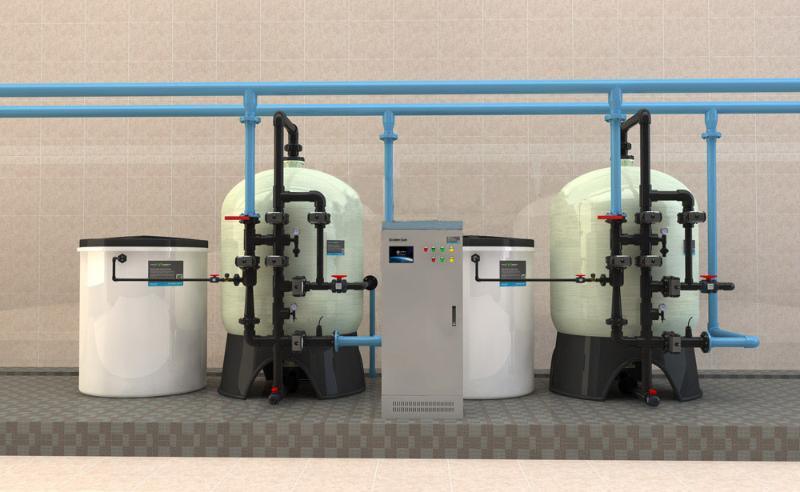
The strong acid cation resin is used to replace the calcium and magnesium ions in the raw water, and then the boiler inlet water filtered by the water softening equipment becomes the softened water for the boiler with extremely low hardness.
 
 
working principle
Ion exchange method
Method: Use a specific cation exchange resin to replace the calcium and magnesium ions in the water with sodium ions. Due to the high solubility of sodium salt, the formation of scale caused by the increase in temperature is avoided.
  
Features and effects: The effect is stable and accurate, and the technology is mature. The hardness can be reduced to 0.
Scope of application: catering, food, chemical, pharmaceutical and other fields, air-conditioning, industrial circulating water and other applications. The most commonly used standard method at present.
  
Electromagnetic method
Method: Add a certain electric or magnetic field to the water to change the characteristics of the ions, thereby changing the deposition rate of calcium carbonate (magnesium carbonate) and the physical characteristics of the deposition to prevent the formation of hard scale.
  
Features and effects: equipment investment is small, installation is convenient, and operating costs are low. The effect is not stable enough, there is no unified measurement standard, and because the main function is only to affect the physical properties of the scale within a certain range, the use time and distance of the treated water have certain limitations.
  
Scope of application: It is mostly used in the treatment of commercial (such as central air-conditioning, etc.) circulating cooling water, but cannot be used in industrial production and boiler make-up water treatment.
  
Membrane separation
Method: Both nanofiltration membrane (NF) and reverse osmosis membrane (RO) can intercept calcium and magnesium ions in the water, thereby radically reducing the hardness of the water.
The hardness can only be reduced to a certain range.
Features and effects: The effect is obvious and stable, and the water after treatment has a wide application range. There are higher requirements for the inlet water pressure, and the equipment investment and operating costs are higher.
Scope of application: Generally, it is rarely used for special softening treatment.

Lime method
Method: Add lime to the water.
Features and effects: The hardness can only be reduced to a certain range.
Applicable range: Applicable range of high-hard water with large flow rate.
  
Dosing
Method: Adding a special scale inhibitor to the water can change the combination of calcium and magnesium ions and carbonate ions, so that scale can not be precipitated and deposited.
Features and effects: less one-time investment and wide adaptability. When the water volume is soft and large, the operating cost is biased.
Scope of application: Due to the addition of chemical substances, the application of water is greatly restricted. Under normal circumstances, it cannot be used in drinking, food processing, industrial production, etc. It is also rarely applied in the civilian field.
Related News
Read More >>
Application of Reverse Osmosis Technology in Industrial Ultrapure Water Production Application of Reverse Osmosis Technology in Industrial Ultrapure Water Production
Dec .19.2025
To effectively address this challenge, reverse osmosis technology has been introduced to enhance the efficiency and resource utilization of ultrapure water production.
Small Industrial RO Systems Keep Breaking Down? 5 Common Failures + Solutions to Streamline Maintenance Small Industrial RO Systems Keep Breaking Down? 5 Common Failures + Solutions to Streamline Maintenance
Dec .19.2025
Today we'll dissect the 5 most common issues, explaining symptoms and troubleshooting steps clearly. After reading this, you'll troubleshoot confidently—no more panic!
Knowledge Summary on Water Softening and Water Softening Equipment Knowledge Summary on Water Softening and Water Softening Equipment
Dec .19.2025
Softened water refers to water from which hardness (primarily calcium and magnesium ions) has been removed or reduced to a certain degree.
From Turbid to Clear: The Working Secrets of Reverse Osmosis Systems From Turbid to Clear: The Working Secrets of Reverse Osmosis Systems
Dec .18.2025
Reverse osmosis systems are far more than a simple combination of membrane housings and pumps; they represent separation engineering grounded in thermodynamics and materials science.