Water purification information

How to choose an air purifier

Views : 138975
Update time : 2021-08-05 15:14:40
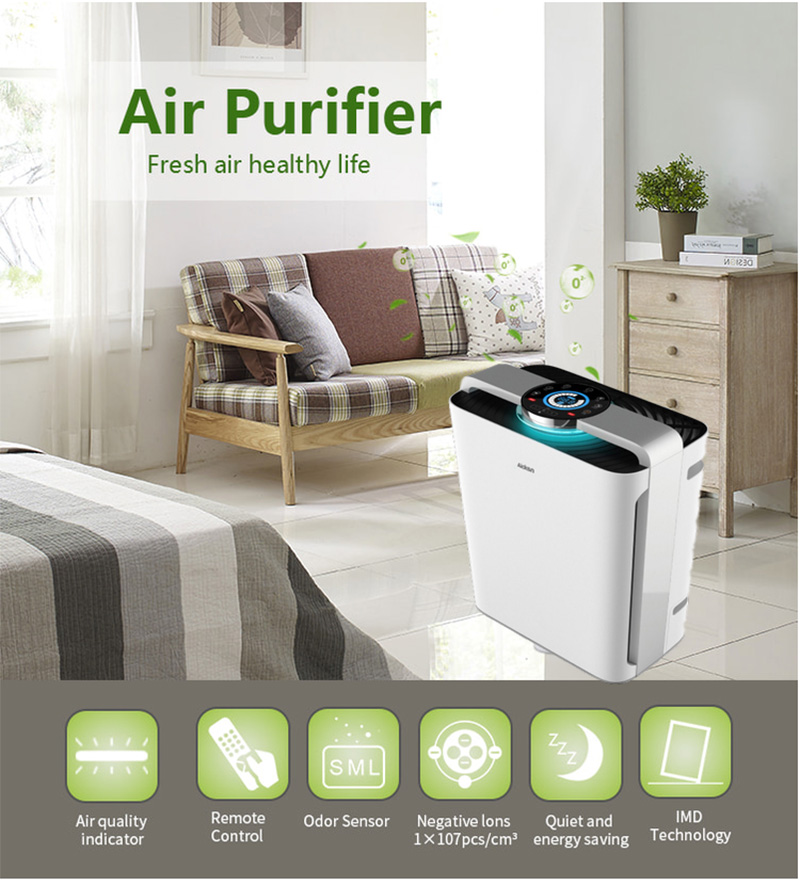
First of all, choose according to the use area of ​​the room; the use area is related to the CADR value of the air purifier. Generally, the required CADR value should reach five times the space of the house. Next, look at the filter of the purifier; the filter is the core of the removal of pollutants, and the filtration level of the HEPA filter is also different. Among them, the H13 filter has the best filtering effect, which can remove 99.99% of the pollutants. Also pay attention to the CCM value of the filter, which represents the ability of the filter to accumulate and purify pollutants.
How to choose an air purifier:
1. Choose according to the use area of ​​the room. The use area is related to the CADR value of the air purifier, so you should pay attention and consider when choosing an air purifier. CADR means clean air output rate. The greater the CADR output rate, the stronger the capacity. When buying air purifiers with different CADR values ​​according to different space areas, generally the CADR value purchased is equal to five times the house space. For example, for a room of 30 square meters and 3 meters high, the space occupied by objects such as sofas can be calculated as 90m3 meters, and then multiplied by 5, which requires an air purifier with a CADR of 450.

2. Look at the purifier filter, the general purifier filter is a HEPA filter, which is the core weapon to remove PM2.5. The same HEPA filter also has different filtration levels, generally H11, H12, and H13. The filtering effect of H11 is 99%, the filtering effect of H12 is 99.9%, and the filtering effect of H13 is 99.99%. The higher the level of the filter, the better. Secondly, pay attention to the CCM value of the filter, which represents the ability of the filter to accumulate and purify pollutants. Among them, the solid pollutant CCM is divided into P1, P2, P3, P4 from low to high, and the gaseous pollutant CCM is F1, F2, F3, F4 from low to high.

3. Looking at the noise situation, the air purifier will definitely produce noise during use, but excessive noise will affect our lives. Therefore, it is necessary to choose a reasonable design air duct and optimize the filter material, so that the effect of reducing resistance and reducing noise can be achieved.
Precautions for the use of air purifiers:
1. The use of air purifiers is similar to large appliances such as refrigerators and air conditioners and needs to be turned on for a long time. In addition, it is necessary to keep a certain distance from it when in use, and do not disassemble the machine with electricity.

2. Prevent the air purifier from entering water. Do not put the air purifier together with the water container and humidifier. In this way, water vapor will enter the machine and cause damage to the machine.

3. When using the air purifier, in order to use the effect better, you need to keep the doors and windows closed. However, long-term confinement can also cause air turbidity and the growth of bacteria. Therefore, proper opening of windows for ventilation at noon when the sun is relatively sufficient and the outdoor pollutant content is small is also very beneficial to the use of the purifier.

4. Clean the filter regularly, wipe and remove dust from the air outlet, air inlet and internal filter of the purifier regularly every half a month or a month. This can extend the service life of the filter.
Related News
Read More >>
Application of Reverse Osmosis Technology in Industrial Ultrapure Water Production Application of Reverse Osmosis Technology in Industrial Ultrapure Water Production
Dec .19.2025
To effectively address this challenge, reverse osmosis technology has been introduced to enhance the efficiency and resource utilization of ultrapure water production.
Small Industrial RO Systems Keep Breaking Down? 5 Common Failures + Solutions to Streamline Maintenance Small Industrial RO Systems Keep Breaking Down? 5 Common Failures + Solutions to Streamline Maintenance
Dec .19.2025
Today we'll dissect the 5 most common issues, explaining symptoms and troubleshooting steps clearly. After reading this, you'll troubleshoot confidently—no more panic!
Knowledge Summary on Water Softening and Water Softening Equipment Knowledge Summary on Water Softening and Water Softening Equipment
Dec .19.2025
Softened water refers to water from which hardness (primarily calcium and magnesium ions) has been removed or reduced to a certain degree.
From Turbid to Clear: The Working Secrets of Reverse Osmosis Systems From Turbid to Clear: The Working Secrets of Reverse Osmosis Systems
Dec .18.2025
Reverse osmosis systems are far more than a simple combination of membrane housings and pumps; they represent separation engineering grounded in thermodynamics and materials science.