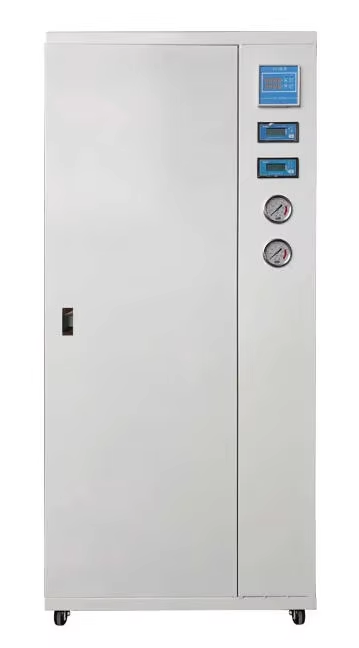
Reverse osmosis ultrapure water equipment is a device used to remove impurities and pollutants in water, but it will inevitably encounter some problems during normal operation and use. How should these problems be solved?

The following are some common pure water machine problems and corresponding solutions:
1. Impure water quality: If the water quality of your reverse osmosis ultrapure water equipment does not meet the expected requirements, you need to check whether the inlet water source is pure.

If there is a problem with the water source, it will affect the water output of the pure water machine.
►The solution is to ensure that the quality of the inlet water source is good.
2. Low water production: Sometimes the water production per hour of the pure water machine may be insufficient.
This may be due to the obstruction of the filter element of the equipment or insufficient water pressure.
 ►The Solution:
 The filter element needs to be cleaned or replaced in time or the water pressure needs to be increased.
3. Leakage problem: If the equipment is found to have a leakage problem, it is necessary to check whether the pipe connection is tight and whether the water storage tank has cracks or damage.

►The solution is to repair the leak and ensure that the connection is firm.
4. Water temperature is too low: Some pure water machines have a hot water function. If you find that the water temperature is not hot enough, the heating element may be faulty.
►Solution: You need to contact the manufacturer or equipment maintenance personnel to repair the heating element.
5. Noise problem: The pure water machine may make noise when running, which is usually caused by problems with the water pump or pressure regulator.
►Solution: Check these parts and repair or replace them.
6. The system cannot start: If your reverse osmosis ultrapure water equipment cannot start, check whether the power supply is connected normally, whether the switch is turned on, and whether the circuit is faulty.
►If the problem persists, contact maintenance personnel for diagnosis and repair.
7. Leak detection: Some pure water machines are equipped with a leak detection function and stop running after detecting a leak.
If the system stops working and a water leak alarm occurs, check the water leak sensor, clean or replace it, and restart the system.
Reverse osmosis ultrapure water equipment is an important equipment for keeping the laboratory water pure
► Regular maintenance can ensure its continued efficient operation. If you are not sure how to solve the problem, it is recommended to seek help from professional maintenance personnel.
Susan hopes this article can help you. If you have other questions about water treatment, please leave a message in the comment area, I will reply as soon as possible. If you think my article is useful, want to know more about water treatment knowledge or want to buy related water treatment water purifier equipment, etc., please contact me through the following business card. Thank you for reading, I wish you a happy life!

 Analysis of the Structure and Working Principle of Ultrapure Water Equipment
 Tips for Using Home Water Purifier Filter Cartridges
 The Battle of Four Membranes: Microfiltration, Ultrafiltration, Nanofiltration, Reverse Osmosis—Which Reigns Supreme in Water Purification?
 Don't Pay for Stupidity! The Ultimate 2026 Water Purifier Guide: Selection, Pitfalls, and Maintenance All in One Article