Ultrafiltration membrane can not remove calcium and magnesium ions in water reason
Ultrafiltration membrane has a strong filtration and purification treatment effect, mainly used to retain harmful substances in water, while maintaining the pH value of produced water unchanged. While ultrafiltration can effectively remove large proteins, bacteria and similar substances, if you want to remove calcium and magnesium ions, it is recommended that you can use nanofiltration membrane or reverse osmosis membrane.
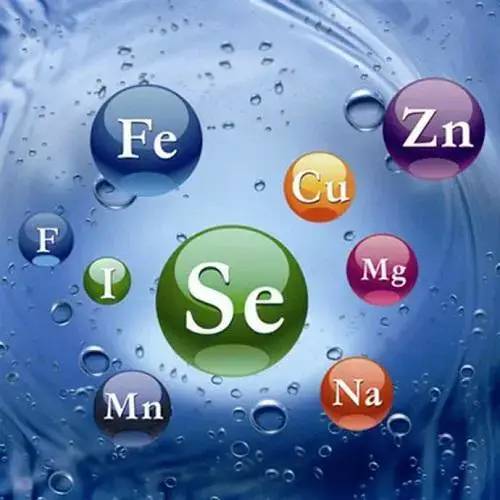
Membrane treatment can be generally divided into ultrafiltration, nanofiltration and reverse osmosis. The ultrafiltration membrane you are referring to has a general pore size of 0.1-0.01um and a molecular weight of 1000-300,000 molecules. The diameter and molecular weight of calcium and magnesium ions are much smaller than this value. Therefore, it is through the ultrafiltration membrane.

1、The concept of ultrafiltration
The application of ultrafiltration membrane with a pore size of 1.0-20.0nm or larger to filter the solution containing macromolecules or fine particles, so that the macromolecules or fine particles are separated from the solution is called ultrafiltration.
2, the characteristics of ultrafiltration
Similar to reverse osmosis, the driving force of ultrafiltration is also differential pressure, the solution side of the pressure, so that the solvent through the membrane and get separated. Unlike reverse osmosis, in the ultrafiltration process, small molecules of solute will be with the solvent through the ultrafiltration membrane.
3, the essence of ultrafiltration
The essence of ultrafiltration is the sieving effect, particle adsorption and clogging in the microporous membrane surface.
Ultrafiltration membrane is a non-symmetrical membrane, its surface active layer has pore size 10-9 ~ 2 × 10⁻⁸m microporous, able to retain the relative molecular weight of 500 or more macromolecules and colloidal particles, the differential pressure used for 0.1 ~ 0.5MPa.
But the ultrafiltration reverse osmosis membrane can remove the scaling core in the water, such as colloids, can reduce the degree of scaling to a certain extent.
4. Advantages of ultrafiltration membrane
Due to water pollution and secondary pollution is quite serious, with ordinary filtration media is difficult to realize the effect of deep purification of drinking water. Ultrafiltration membrane purification technology using high-precision pure physical filtration principle, without adding any chemical substances, relying on the ultrafiltration membrane surface densely packed with microscopic holes for sieving, thus retaining harmful substances, thus achieving filtration purification, purification effect.

Through various reasons, the development of membrane technology and production scale, so that the performance of ultrafiltration membrane is more stable. However, ultrafiltration membrane is not the mainstream technology to remove calcium and magnesium ions from water

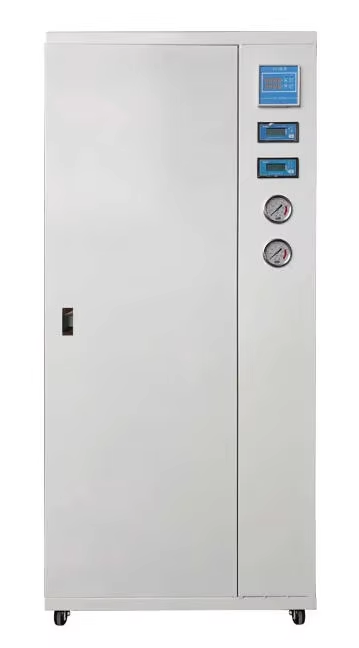 Analysis of the Structure and Working Principle of Ultrapure Water Equipment
 Tips for Using Home Water Purifier Filter Cartridges
 The Battle of Four Membranes: Microfiltration, Ultrafiltration, Nanofiltration, Reverse Osmosis—Which Reigns Supreme in Water Purification?
 Don't Pay for Stupidity! The Ultimate 2026 Water Purifier Guide: Selection, Pitfalls, and Maintenance All in One Article