Do you know the difference between ultrapure water equipment and pure water equipment?
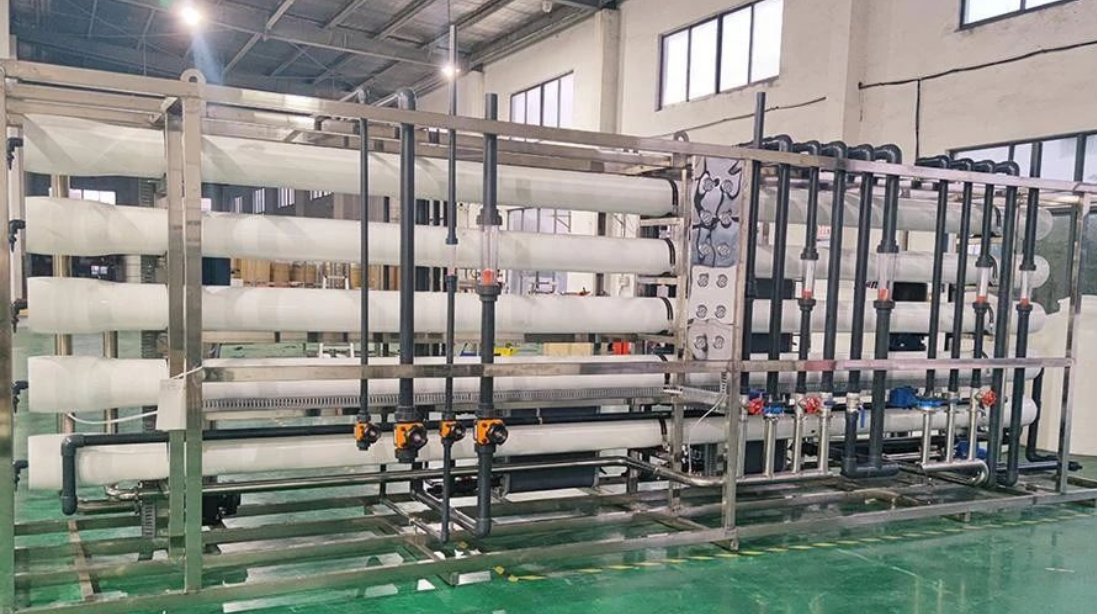
Ultrapure water equipment is the use of pre-treatment, reverse osmosis technology, ultra-purification treatment and post-treatment methods, the conductive medium in the water is almost completely removed, and the water will not dissociate the colloidal substances, gases and organic matter are removed to a very low degree of water treatment equipment.
Pure water equipment, it is mainly reverse osmosis membrane technology. Its working principle is to exert a certain pressure on the water, so that the water molecules and ionic mineral elements through the reverse osmosis membrane, and dissolved in the water of the vast majority of inorganic salts (including heavy metals), organics, and bacteria, viruses, etc. can not pass through the reverse osmosis membrane, so that the infiltration of the pure water and can not be infiltrated through the concentration of the water is strictly separate; Reverse osmosis membrane pore size is only 0.0001 microns, and the viral The diameter of the reverse osmosis membrane is only 0.0001 microns, while the virus is generally 0.02-0.4 microns, the diameter of ordinary bacteria is 0.4-1 microns.
First, the use of different
(A) the use of ultrapure water equipment:
1, the production and cleaning of ultrapure materials and ultrapure reagents.
2, the production and cleaning of electronic products.
3, the production of battery products.
4, the production and cleaning of semiconductor products.
5、Production and cleaning of circuit boards.
6, the production of other high-tech fine products.
(B) the use of pure water equipment:
1, power plant chemical water treatment
2, electronics, semiconductors, precision machinery industry ultrapure water
3, food, beverage, drinking water preparation
4, small pure water station, group drinking pure water
5、Fine chemical industry, precision discipline water
6、Other industries required for the preparation of high-purity water
7、Pharmaceutical industry process water
8, seawater, brackish water desalination
Second, the conductivity of water is different
1. ultrapure water quality: resistivity > 15MΩ.cm ultrapure water quality is divided into five industry standards, respectively, 18MΩ.cm, 15MΩ.cm, 10MΩ.cm, 2MΩ.cm, 0.5MΩ.cm, in order to distinguish between different water quality.
2. Pure water is divided into: industrial pure water and drinking pure water industrial pure water: in 25 degrees Celsius, the
1. Ordinary pure water:EC=1~10us/cm; 2.
2. high purity water:EC=0.1~1.0us/cm; 3. ultra-pure water:EC=0.1~1.0us/cm.
3. ultrapure water:EC=0.1~0.055; drinking pure water:EC=1~10 us/cm(national standard).
III. Different processes used between the various types of equipment
(A) the process flow of ultrapure water equipment is:
1、Pre-treatment system → reverse osmosis system → intermediate water tank → coarse mixed bed → fine mixed bed → pure water tank → pure water pump → ultraviolet steriliser → polished mixed bed → precision filter → water object (≥18MΩ.CM) (traditional process).
2、Pre-treatment → reverse osmosis → intermediate water tank → water pump → EDI device → purified water tank → pure water pump → ultraviolet steriliser → polished mixed bed → 0.2 or 0.5μm precision filter → water object (≥18MΩ.CM) (the latest process).
3、Pre-treatment → first-stage reverse osmosis → dosing machine (PH adjustment) → intermediate water tank → second-stage reverse osmosis (positively charged reverse osmosis membrane) → pure water tank → pure water pump → EDI device → ultraviolet steriliser → 0.2 or 0.5 μm precision filter → water-using objects (≥17MΩ.CM) (the latest process).
4、Pre-treatment → reverse osmosis → intermediate water tank → water pump → EDI device → pure water tank → pure water pump → ultraviolet steriliser → 0.2 or 0.5μm precision filter → water object (≥15MΩ.CM) (the latest process).
5、Pre-treatment system → reverse osmosis system → intermediate tank → pure water pump → coarse mixed bed → fine mixed bed → ultraviolet steriliser → precision filter → water object (≥15MΩ.CM) (traditional process).
(ii) The process flow of pure water equipment is:
1, using ion exchange
Raw water → raw water pressure pump → multi-media filter → activated carbon filter → water softener → precision filter → positive resin filter bed → negative resin filter bed → anion and Yang resin mixing bed → microporous filter → water points
2、Adopting two-stage reverse osmosis
Raw water → raw water pressure pump → multi-media filter → activated carbon filter → water softener → precision filter → the first stage of reverse osmosis → PH adjustment → intermediate water tank → the second stage of reverse osmosis (reverse osmosis membrane surface positive charge) → purification tank → pure water pump → microporous filter → point of water use
3、Using EDI method
Raw water → raw water pressure pump → multi-media filter → activated carbon filter → water softener → precision filter → a reverse osmosis machine → intermediate water tank → intermediate water pump → EDI system → microporous filter → water points

 Analysis of the Structure and Working Principle of Ultrapure Water Equipment
 Tips for Using Home Water Purifier Filter Cartridges
 The Battle of Four Membranes: Microfiltration, Ultrafiltration, Nanofiltration, Reverse Osmosis—Which Reigns Supreme in Water Purification?
 Don't Pay for Stupidity! The Ultimate 2026 Water Purifier Guide: Selection, Pitfalls, and Maintenance All in One Article